Showing posts with label Awesome Architecture Designs. Show all posts

Low impact woodland house (Wales, UK)

Location: Wales, UK
Architect: Simon Dale
Purpose: private house
More info: From the author: “You are looking at pictures of a house I built for our family in Wales. It was built by myself and my father in law with help from passers by and visiting friends. 4 months after starting we were moved in and cosy. I estimate 1000-1500 man hours and £3000 put in to this point. Not really so much in house buying terms (roughly £60/sq m excluding labour).”

“The house was built with maximum regard for the environment and by reciprocation gives us a unique opportunity to live close to nature.” he says.

This building is one part of a low-impact or permaculture approach to life. This sort of life is about living in harmony with both the natural world and ourselves, doing things simply and using appropriate levels of technology.
When asked why he is doing this, he gave this answer: “ It’s fun. Living your own life, in your own way is rewarding. Following our dreams keeps our souls alive.”


  • Dug into hillside for low visual impact and shelter
  • Stone and mud from diggings used for retaining walls, foundations etc.
  • Frame of oak thinnings (spare wood) from surrounding woodland
  • Reciprocal roof rafters are structurally and aesthaetically fantastic and very easy to do
  • Straw bales in floor, walls and roof for super-insulation and easy building
  • Plastic sheet and mud/turf roof for low impact and ease
  • Lime plaster on walls is breathable and low energy to manufacture (compared to cement)
  • Reclaimed (scrap) wood for floors and fittings
  • Anything you could possibly want is in a rubbish pile somewhere (windows, burner, plumbing, wiring…)
  • Woodburner for heating - renewable and locally plentiful
  • Flue goes through big stone/plaster lump to retain and slowly release heat
  • Fridge is cooled by air coming underground through foundations
  • Skylight in roof lets in natural feeling light
  • Solar panels for lighting, music and computing
  • Water by gravity from nearby spring
  • Compost toilet
  • Roof water collects in pond for garden etc.

Main tools used: chainsaw, hammer and 1 inch chisel, little else really. Oh and by the way I am not a builder or carpenter, my experience is only having a go at one similar house 2yrs before and a bit of mucking around inbetween. This kind of building is accessible to anyone. My main relevant skills were being able bodied, having self belief and perseverence and a mate or two to give a lift now and again.

50 Strange Buildings of the World

1. The Crooked House (Sopot, Poland)

Construction of the building started in in January 2003 and in December 2003 it was finished. House architecture is based on Jan Marcin Szancer (famous Polish artist and child books illustrator) and Per Dahlberg (Swedish painter living in Sopot) pictures and paintings.


2. Forest Spiral – Hundertwasser Building (Darmstadt, Germany)

The Hundertwasser house “Waldspirale” (”Forest Spiral”) was built in Darmstadt between 1998 and 2000. Friedensreich Hundertwasser, the famous Austrian architect and painter, is widely renowned for his revolutionary, colourful architectural designs which incorporate irregular, organic forms, e.g. onion-shaped domes.

The structure with 105 apartments wraps around a landscaped courtyard with a running stream. Up in the turret at the southeast corner, there is a restaurant, including a cocktail bar.


3. The Torre Galatea Figueras (Spain)


4. Ferdinand Cheval Palace a.k.a Ideal Palace (France)

5. The Basket Building (Ohio, United States)

The Longaberger Basket Company building in Newark, Ohio might just be a strangest office building in the world. The 180,000-square-foot building, a replica of the company’s famous market basket, cost $30 million and took two years to complete. Many experts tried to persuade Dave Longaberger to alter his plans, but he wanted an exact replica of the real thing.


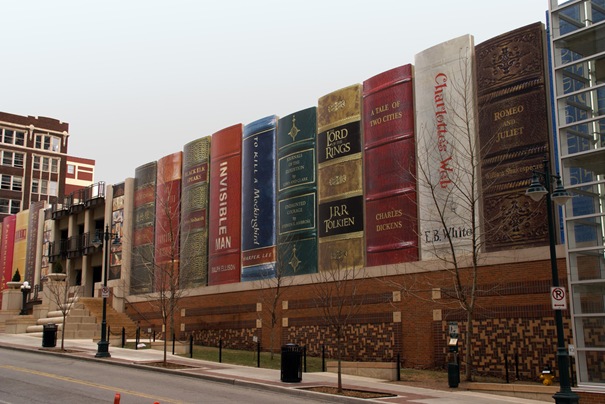
6. Kansas City Public Library (Missouri, United States)

This project, located in the heart of Kansas City, represents one of the pioneer projects behind the revitalization of downtown.

The people of Kansas City were asked to help pick highly influential books that represent Kansas City. Those titles were included as ‘bookbindings’ in the innovative design of the parking garage exterior, to inspire people to utilize the downtown Central Library.


7. Wonderworks (Pigeon Forge, TN, United States)


8. Habitat 67 (Montreal, Canada)

Expo 67, one of the world’s largest universal expositions was held in Montreal. Housing was one of the main themes of Expo 67.

The cube is the base, the mean and the finality of Habitat 67. In its material  sense, the cube is a symbol of stability. As for its mystic meaning, the cube is symbol of wisdom, truth, moral perfection, at the origin itself of our civilization.

354 cubes of a magnificent grey-beige build up one on the other to form 146 residences nestled between sky and earth, between city and river, between greenery and light.


9. Cubic Houses (Rotterdam, Netherlands)

The original idea of these cubic houses came about in the 1970s. Piet Blom has developed a couple of these cubic houses that were built in Helmond.

The city of Rotterdam asked him to design housing on top of a pedestrian bridge and he decided to use the cubic houses idea. The concept behind these houses is that he tries to create a forest by each cube representing an abstract tree; therefore the whole village becomes a forest.


10. Hang Nga Guesthouse a.k.a Crazy House (Vietnam)

The house is owned by the daughter of the ex-president of Vietnam, who studied architecture in Moscow.

It does not comply with any convention about house building, has unexpected twists and turns, roofs and rooms. It looks like a fairy tale castle, it has enormous “animals” like a giraffe and a spider, no window is rectangular or round, and it can be visited like a museum.


11. Chapel in the Rock (Arizona, United States)


12. Dancing Building (Prague, Czech Republic)


13. Calakmul building a.k.a La Lavadora a.k.a The Washing Mashine (Mexico, Mexico)


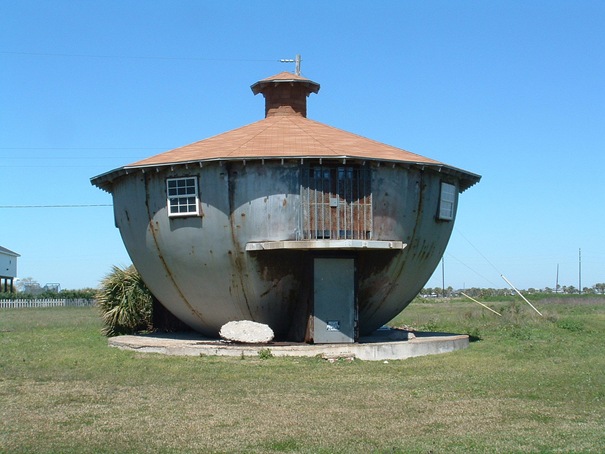
14. Kettle House (Texas, United States)


15. Manchester Civil Justice Centre (Manchester, UK)


16. Nakagin Capsule Tower (Tokyo, Japan)


17. Mind House (Barcelona, Spain)


18. Stone House (Guimarães, Portugal)


19. Shoe House (Pennsylvania, United States)


20. Weird House in Alps


50 Strange Buildings of the World (Continue)

1. The Ufo House (Sanjhih, Taiwan)


2. The Hole House (Texas, United States)


3. Ryugyong Hotel (Pyongyang, North Korea)


4. The National Library (Minsk, Belarus)


5. Grand Lisboa (Macao)


6. Wall House (Groningen, Netherlands)


7. Guggenheim Museum (Bilbao, Spain)


8. Bahá’í House of Worship a.k.a Lotus Temple (Delhi, India)


9. Container City (London, UK)


10. Erwin Wurm: House Attack (Viena, Austria)


11. Wooden Gagster House (Archangelsk, Russia)


12. Air Force Academy Chapel (Colorado, United States)


13. Solar Furnace (Odeillo, France)


14. Dome House (Florida, United States)


15. Beijing National Stadium (Beijing, China)


16. Fashion Show Mall (Las Vegas, United States)


17. Luxor Hotel & Casino (Las Vegas, United States)


18. Zenith Europe (Strasbourg, France)


19. Civic Center (Santa Monica)


20. Mammy’s Cupboard (Natchez, MS, United States)


21. Pickle Barrel House (Grand Marais, Michigan, United States)


22. The Egg (Empire State Plaza, Albany, New York, United States)


23. Gherkin Building (London, UK)


24. Nord LB building (Hannover, Germany)


25. Lloyd’s building (London, UK)


26. “Druzhba Holiday Center Hall (Yalta, Ukraine)


27. Fuji television building (Tokyo, Japan)


28. UCSD Geisel Library (San Diego, California, United States)


29. Ripley’s Building (Niagara Falls, Ontario, Canada)


30. The Bank of Asia a.k.a Robot Building (Bangkok, Thailand)